Present like a firm twice your size, without leaking what it costs you.
Margin-safe proposals and branded portals on your own domain. Look enterprise. Stay lean.
Scope from your products, priced by your rules.
Run your client pipeline, and a second pipeline tracks hiring alongside with its own stages. Build the scope from products and deliverables. Option groups give a price and an hours range on your fixed base, and the end date projects from real hours.

From a live workspace running on Emerjent.
Your client picks options. Cost and margin never leave your side.
Redaction happens on the server. The client toggles options and watches the range settle while you keep every figure. The cost, margin, and rate rows aren't blurred, they're replaced, so there is nothing to peek at.
Switch views to see exactly what your client sees versus your internal figures.

No more “can you resend that file?”
A per-client portal in your brand: scope, updates, milestones, meeting notes, onboarding with secure credential capture, and deliverables as they ship. The client sees the redacted view, you keep the full one, and delivery tracking holds phases, payments, documents, and decisions.
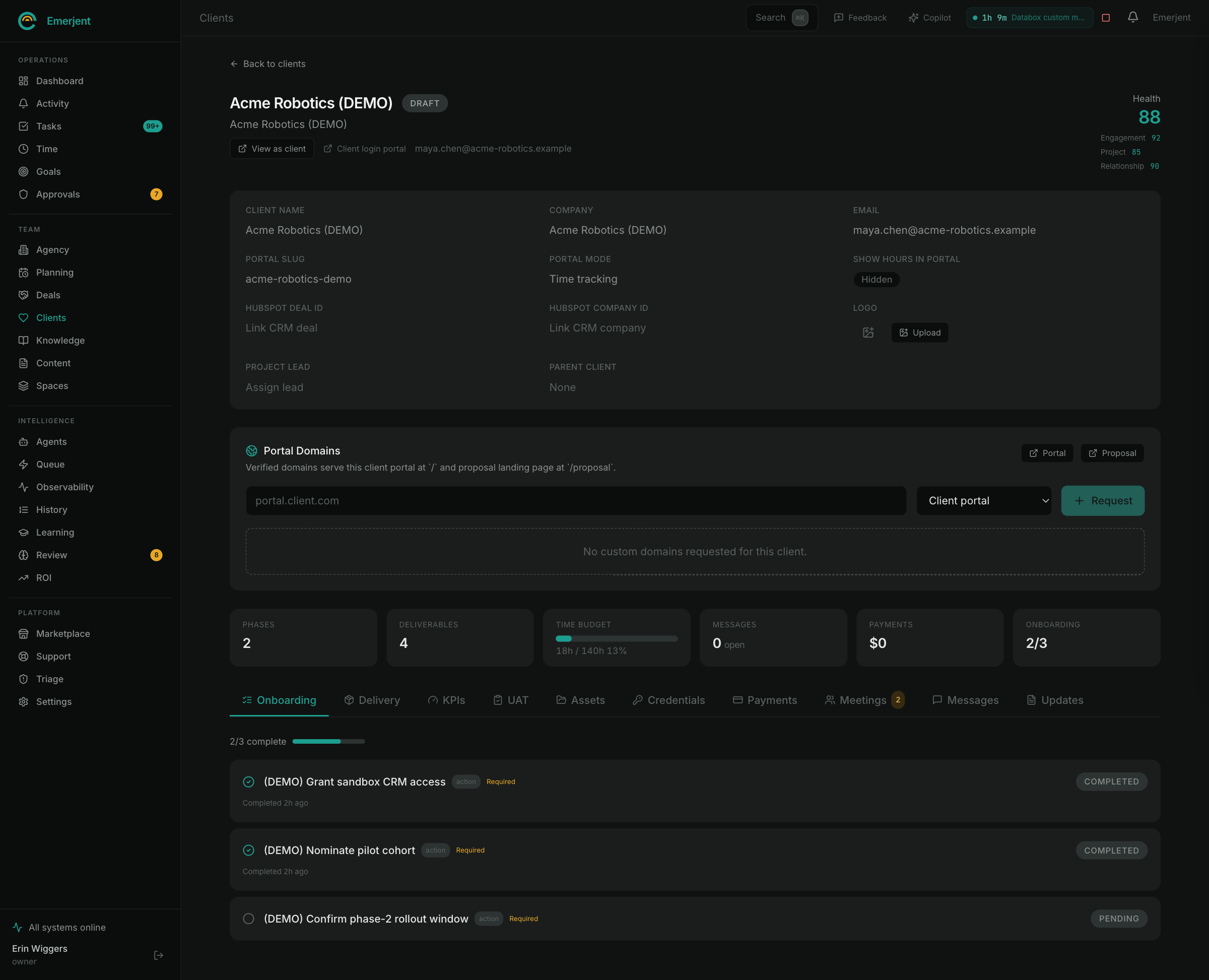
Know which client is slipping before they tell you.
Health scoring with at-risk alerts
Automatic health scores surface the client who's slipping, with an alert before it becomes a renewal conversation.
RFP handling
List and create RFPs, score them, and manage their questions. A practical way to keep bids organized, not an overclaim.
HubSpot activity, synced in
Calls, meetings, emails, and notes flow in from HubSpot on a schedule, resolved to the right client and deal. Read-only and deterministic, with no LLM in the loop.
Look like the firm you're becoming.
Proposals and portals carry your identity on your domain. A parent and child client structure cascades a contracting agency's brand down to its clients. Selling your model is on the resell page.
Questions people ask about this.
What is the purpose of a client portal?
A client portal gives each client one place to see their engagement: scope, updates, milestones, meeting notes, onboarding, and deliverables as they ship. It replaces the resend-that-file email thread. On Emerjent, every portal carries your brand and runs on your own domain.
Is a client portal different from a website?
Yes. A website is public and the same for everyone. A client portal is private and scoped to one client: their project, their documents, their sign-offs. Emerjent portals carry your brand on your domain, so to the client it feels like part of your firm.
Is a client portal safe?
It depends on how it is built. Emerjent portals are scoped per client at the database, redaction happens on the server so cost and margin never reach the client's browser, and onboarding uses secure credential capture. The client sees their engagement and nothing else.