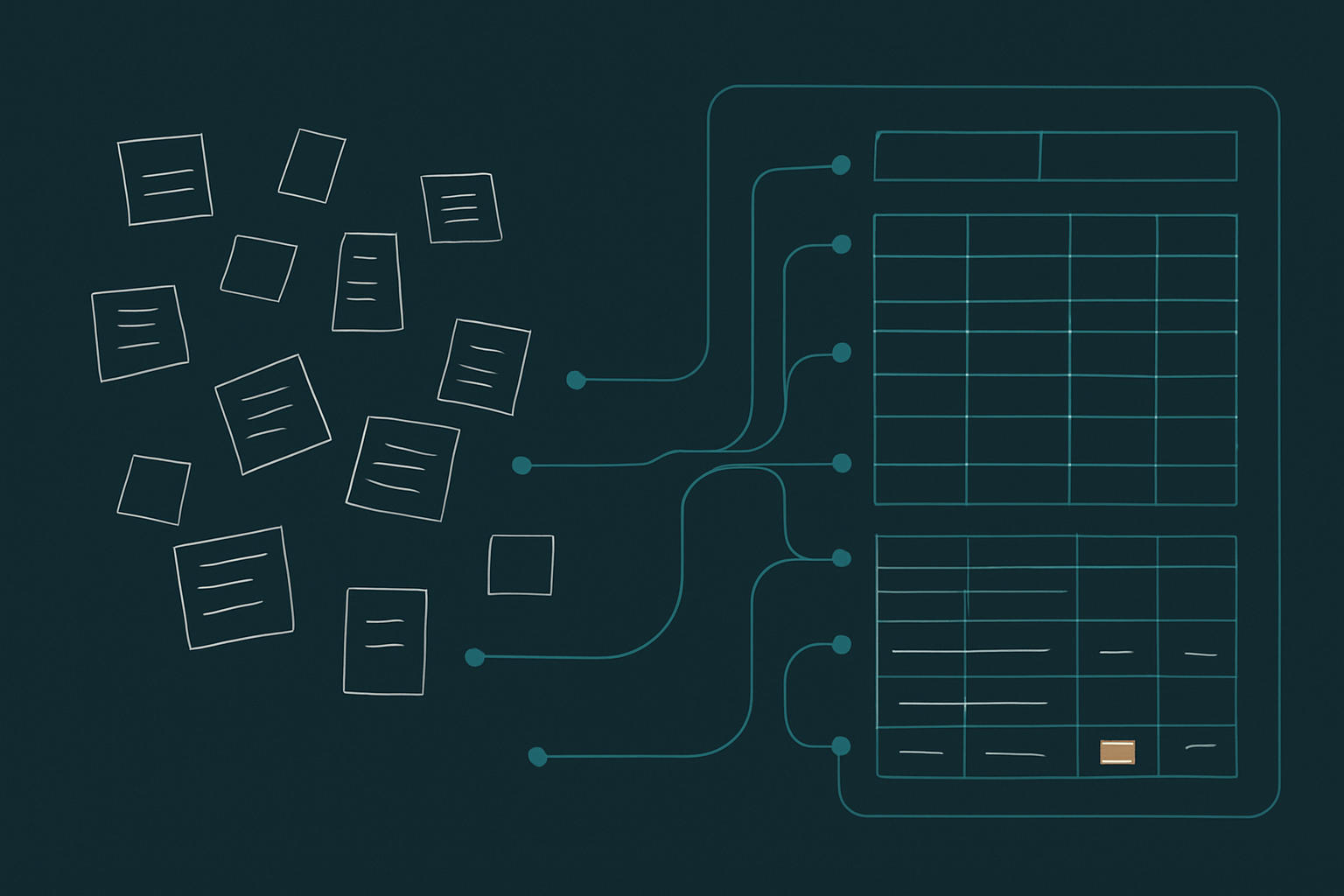
You just finished a good discovery call. You know the client's problem, their timeline pressure, their budget range. What comes next is the scope of work: deliverables, a timeline, a cost, and who's doing what.
For most agencies and consulting firms, this is where the deal slows down. Someone opens last quarter's proposal, strips out the client name, and starts guessing at hours. The scope that comes out the other end depends on who wrote it and how much time they had, not on what the engagement actually requires.
What project scoping actually has to do
A scope of work has one job: translate what you learned in discovery into something you can commit to and deliver against. That means three things have to be explicit:
→ Your client knows exactly what they're getting: the actual deliverables, not a vague description of the engagement → You and the client agree on cost and timeline before work starts, not after → You can staff without overbooking, because you know who's doing the work and how much of their time it takes
Miss any one of those and you're negotiating scope creep later, or eating margin because the estimate was off, or double-booking a consultant who was already committed to another client.
The hidden cost of bespoke scoping
Building a scope from a blank page every time has a hidden cost: it's slow, and it's inconsistent. Two similar engagements can come out with different timelines and different pricing depending on who scoped them and what mood they were in. That inconsistency is hard to defend to a client and hard to staff against internally.
The fix is templates: build once, assemble from proven patterns instead of rebuilding from scratch every time.
How Emerjent scopes an engagement
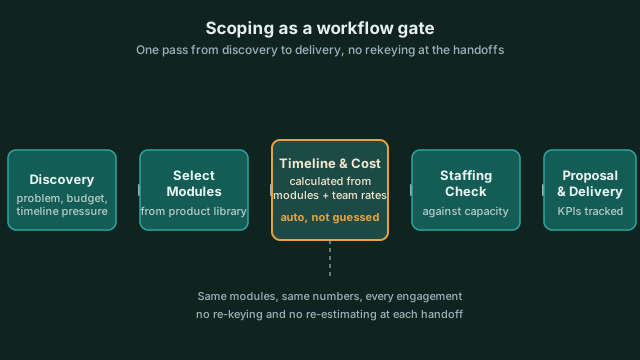 Scoping runs as one continuous workflow: modules feed timeline and cost automatically, staffing checks capacity, and the result flows straight into the proposal.
Emerjent runs scoping as a defined step between discovery and proposal, not a separate exercise you do in a doc or a spreadsheet.
Your scope stays consistent across clients. You define your service modules once, things like 'RevOps Audit' or 'CRM Implementation, Phase 1', built as reusable units with their own scope, timeline, and cost baked in. When a new engagement needs that module, you select it instead of reinventing the structure. You're assembling from what you've already defined and proven works.
Your timeline comes from the work, not a guess. Once you've selected the product modules for an engagement, Emerjent computes the project duration based on those modules and the team you assign. You're not estimating weeks by feel; the number comes from the actual scope you selected.
Your pricing stays accurate without manual math. Cost follows the same logic: it's derived from the product library's pricing, your team's rates, and the calculated timeline. That removes the manual math (and the manual math mistakes) from every proposal.
You staff without overbooking anyone. Each engagement maps to the roles it actually needs: consultant, project manager, specialist, whatever your delivery model requires. You can see capacity utilization across your team as you scope, so you're not committing a consultant who's already booked solid for the next six weeks.
Put together, scoping stops being a document you write and becomes a workflow gate: discovery feeds it, and once it's done, it feeds straight into the proposal and then into delivery and KPI tracking. Nothing gets rekeyed or reinterpreted at each handoff.
A worked example
Say you're scoping a CRM cleanup engagement. In discovery, you learned the client needs deduplication, a new pipeline structure, and rep training. In Emerjent, you'd select three product library modules that match: a data-hygiene module, a pipeline-build module, and a training module.
Each module already carries its own baseline timeline and cost from prior engagements. Say the data-hygiene module is built as a 2-week block, the pipeline build as 3 weeks, and training as 1 week. Assign a consultant and a specialist to the relevant modules, and the platform rolls those into a single project timeline and a single cost figure, adjusted for the team you actually assigned. You're assembling from known units, not estimating from nothing.
From scope to delivery
A clean scope is what makes the rest of the engagement predictable. The roles you assigned during scoping are the roles that show up in delivery. The timeline you calculated is the timeline your KPIs get measured against. When scoping is standardized instead of improvised, everything downstream, the proposal, the kickoff, the reporting, inherits that accuracy instead of compounding the guesswork.
You still own the judgment calls: which modules apply, which consultant fits the client, where you flex on price. Emerjent's job is to make sure none of that judgment gets lost in a spreadsheet, and none of the arithmetic has to happen twice.